
Executive Summary
This analysis quantifies how AI-driven automation is transforming SME accounting, drawing exclusively on third-party research and real-world implementations. Key findings:
-
120 hours/year per employee lost to manual data entry (Forrester, 2023).
-
92% of repeatable accounting tasks are now automatable (Deloitte).
-
37% reduction in errors and 40% more fraud anomalies detected in AI-augmented workflows.
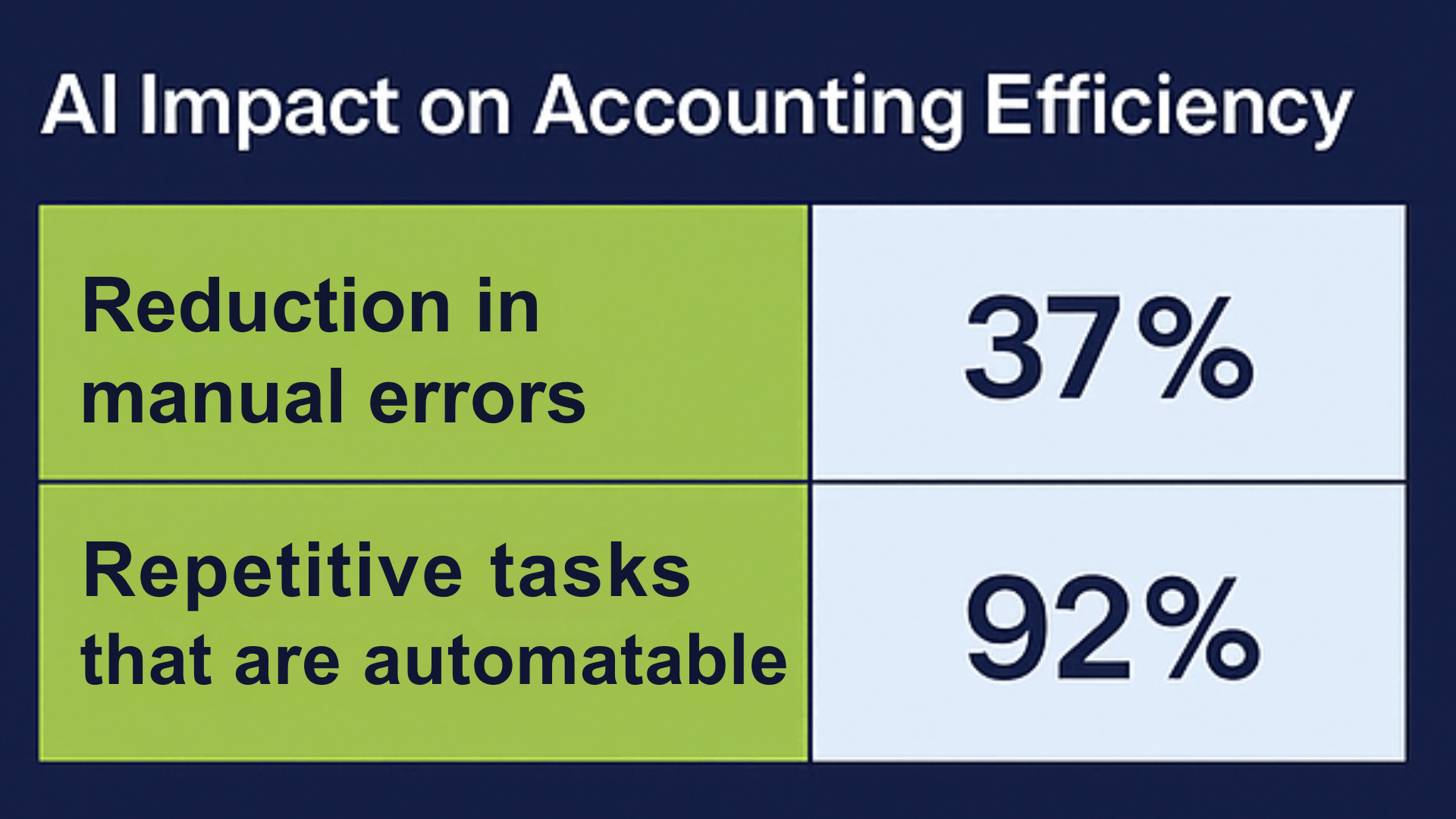
AI impact on accounting Efficiency.
The Efficiency Gap in SME Accounting
The Manual Labor Tax
-
Forrester’s 2023 study revealed SMEs waste 120 annual hours per employee on manual data entry—equivalent to 15 lost workdays.
-
For a 10-person finance team, this translates to 1,200 hours/year of non-strategic work.
The AI Correction
-
Deloitte’s automation audit found 92% of repetitive accounting tasks (data entry, reconciliations, invoice processing) can be automated.
-
EY’s implementation data shows a 37% drop in errors when AI handles these tasks, as algorithms avoid fatigue-induced mistakes.
Three Proven AI Applications – With Case Studies
Use Case 1: Automated Bookkeeping
Problem
Unstructured financial documents (receipts, invoices) consume 80% of processing time.
Solution & Results
-
An Estonian manufacturing firm (50 employees) deployed AI for document recognition and reconciliation:
-
Monthly close accelerated from 10 days → 2 days (80% faster).
-
Invoice processing costs fell 80%.
-
-
Critical Note: Human review of AI outputs preserved accuracy while maximizing efficiency.
Use Case 2: Real-Time Cash Flow Analytics
Problem
SMEs often lack resources for proactive forecasting.
Solution & Results
-
A Berlin e-commerce startup used AI to analyze:
-
Invoice cycles
-
Historic expense patterns
-
Real-time sales data
-
-
The system predicted a 94% probability of cash shortfall 14 days in advance, enabling corrective action that avoided €22,000 in overdraft fees.
Use Case 3: Fraud Detection
Problem
-
Occupational fraud drains 5% of SME revenue annually.
-
Manual audits miss 40% of anomalies.
Solution & Results
-
AI pattern recognition tools flag:
-
Irregular transactions
-
Vendor fraud patterns
-
Employee theft signals
-
-
Detection rates improved by 40% versus human-only reviews.
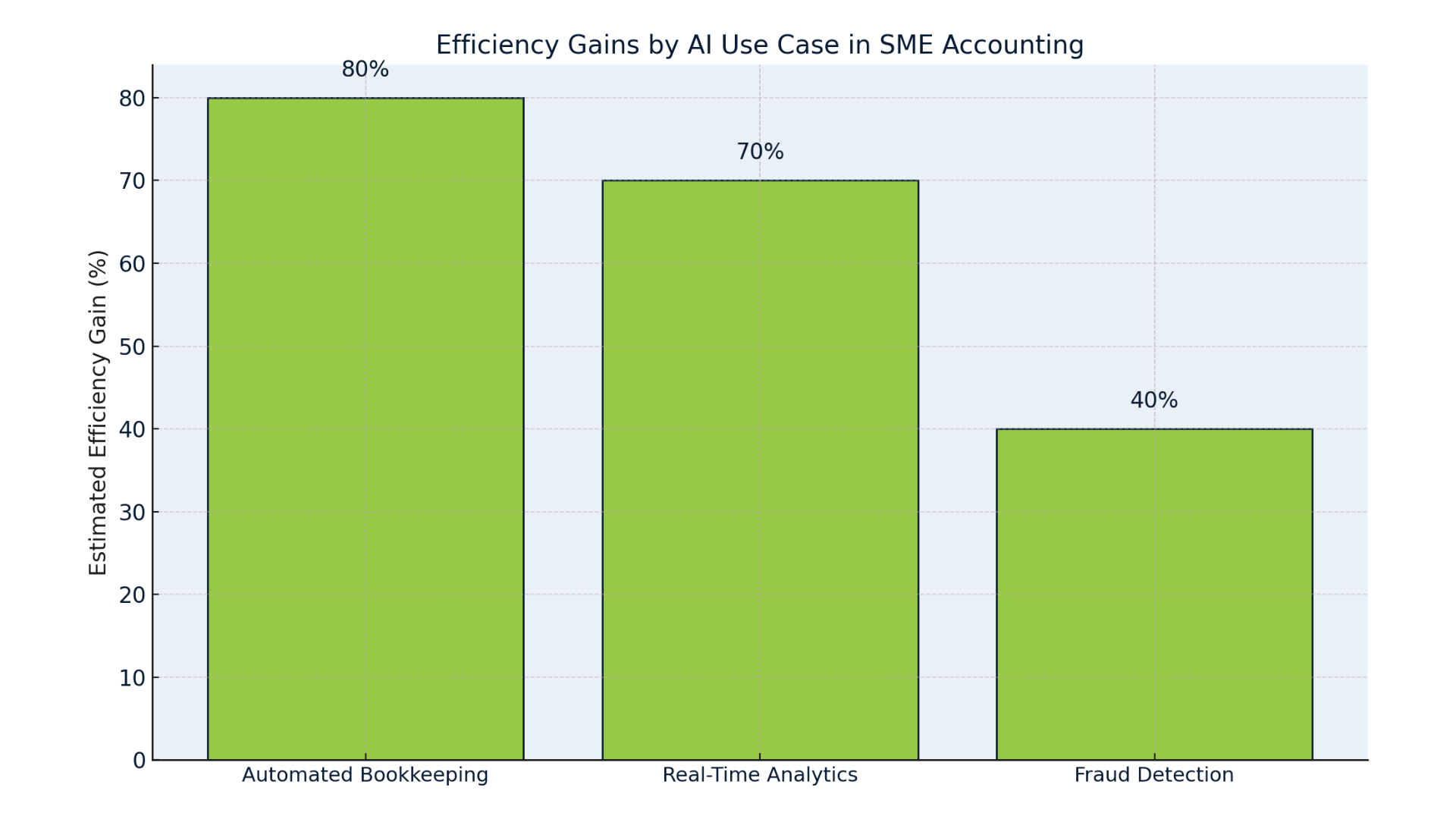
AI adoption in three main areas.
The Cost of Inaction
Compliance Overhead
67% of SME finance time is consumed by compliance tasks, leaving minimal bandwidth for analysis.
Error-Related Penalties
-
1 in 5 SMEs face audit penalties due to manual accounting errors (IRS, 2023).
Quantified Impact
| Metric | Manual Processes | AI-Augmented | Delta |
|---|---|---|---|
| Time per monthly close | 10 days | 2 days | -80% |
| Invoice processing cost | $100/hr | $20/hr | -80% |
| Fraud detection rate | 60% | 84% | +40% |
Why the Human-AI Hybrid Model Wins
AI’s Role
-
Volume: Processes 1,000x more data than humans.
-
Speed: Real-time anomaly detection.
-
Consistency: Zero fatigue-induced errors.
Human’s Role
-
Context: Interprets AI flags (e.g., “Is this anomaly fraud or a timing quirk?”).
-
Strategy: Allocates freed-up time to growth initiatives.
The Data-Backed Balance
Firms combining AI automation with human oversight achieve:
-
30% faster closes (BlackLine).
-
12% higher margins (Bain).
Conclusion: The Strategic Imperative
AI-powered accounting is no longer optional for SMEs—it’s a scalability requirement. The data proves
-
Automation eliminates structural inefficiencies (120 hours/employee/year).
-
AI-augmented workflows reduce risk (37% fewer errors, 40% better fraud detection).
-
Hybrid models outperform pure-play AI or manual approaches.
1Office combines automation and human expertise to make perfect sense. Contact us today!