Lithuania’s position in Europe: small market, global mindset
Lithuania’s economy and growth outlook in 2026
Lithuania has built its economic model around one clear reality: the domestic market is small, so businesses must think internationally from day one. This mindset has shaped a highly export-oriented, innovation-driven economy that continues to attract foreign founders, investors and technology companies.
Located at the geographic midpoint of Europe, Lithuania combines EU and OECD membership with eurozone stability, strong institutions and a business-friendly regulatory framework. The country is part of the EU single market, Schengen area, NATO and WTO, offering legal predictability and access to over 450 million consumers.
According to official national data, Lithuania’s GDP reached €79 billion in 2024, growing by approximately 3% year-on-year, while GDP per capita (PPP) exceeded USD 47,000, placing Lithuania ahead of several Central and Eastern European peers.
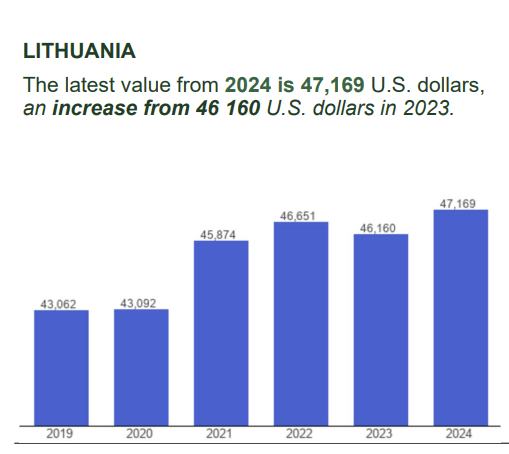
Lithuania: GDP per capita, PPP. Source: The Global Economy
Why Lithuania is resilient during economic uncertainty
Lithuania’s economy has demonstrated resilience through recent global disruptions, including the pandemic, energy price volatility and geopolitical instability in the region. Its economic structure relies on diversified, high-value sectors rather than a single dominant industry.
Official projections indicate continued GDP growth above the EU average in 2025–2026, supported by exports, foreign direct investment and innovation-led productivity gains.
This resilience is one of the reasons Lithuania is increasingly considered a safe operational base for international companies looking to serve EU and global markets.
Lithuania’s innovation ecosystem and government support for businesses
Lithuania’s innovation policy is coordinated through Innovation Agency Lithuania, established in 2022 to unify entrepreneurship, export support and innovation development under one national framework. The agency supports companies at every stage, from market entry to international expansion.
Key areas of support include:
-
business establishment guidance
-
export development and partner search
-
innovation sandboxes and GovTech programmes
-
startup acceleration and funding support
This ecosystem approach is a major advantage for foreign founders unfamiliar with the local environment.
Lithuania’s strongest business sectors in 2026
Key industries driving business growth in Lithuania
Life sciences and biotechnology industry in Lithuania
Lithuania has positioned life sciences as a strategic national priority, with the sector targeting 5% of GDP by 2030. The ecosystem includes over 300 companies, strong university–industry collaboration and rapidly growing exports to the US, Germany, the Netherlands and the UK.
Vilnius and Kaunas rank among the top MedTech hubs in the EU, driven by talent availability and advanced research infrastructure.
ICT, fintech and cybersecurity sector in Lithuania
Lithuania is one of the most digitally advanced economies in Europe. The ICT sector contributes over 8% of total value added, with exports growing at an average rate of 28% annually.
Vilnius has been recognised as a leading EU hub for cybersecurity, while Lithuania ranks first in the EU for licensed fintech companies. Global brands such as Vinted, Nord Security and Teltonika operate from Lithuania, alongside hundreds of scale-ups and startups.
Smart manufacturing and high-tech engineering in Lithuania
Manufacturing accounts for roughly 20% of Lithuania’s GDP, with particular strength in lasers, photonics, electronics and robotics. Lithuanian laser technology is used by 95 of the world’s top 100 universities, including NASA research partners.
Major investments announced through 2025–2026 confirm Lithuania’s role as a competitive production base for advanced manufacturing in the EU.
Defence, energy and infrastructure projects in Lithuania
Defence and security industries are among the fastest-growing sectors, supported by Lithuania’s NATO commitments and increased national defence spending. Renewable energy is another strategic priority, with Lithuania aiming for 100% renewable electricity consumption by 2028 and significant investment in wind, hydrogen and grid infrastructure.
Thinking about doing business in Lithuania?
Setting up and running a company in Lithuania is straightforward when done correctly, but local rules, tax registrations and reporting requirements still matter, especially for international founders.
1Office Lithuania supports companies at every stage, from company formation and tax setup to accounting, payroll and ongoing compliance.
Talk to our local team and get clear guidance before you start.
Tax system and investment incentives for companies in Lithuania
Lithuania offers a competitive corporate tax framework by EU standards. From January 2026, the standard corporate income tax rate increases to 17%, with a 7% preferential rate for qualifying small businesses under specific conditions.
Certain incentives, including R&D tax relief, accelerated depreciation and Free Economic Zone (FEZ) benefits, are available but strictly conditional, project-based and subject to eligibility criteria set by law and Invest Lithuania.
These incentives are not automatic and require careful structuring, documentation and ongoing compliance. This is an area where professional guidance is critical.
Workforce, talent availability and labour market in Lithuania
Lithuania offers a highly educated workforce with strong STEM participation. Over 40% of students choose STEM fields, and Lithuania has one of the highest shares of women engineers and scientists in the EU.
Unemployment remains moderate, while wage growth reflects increasing productivity rather than labour shortages. For international employers, this provides a balanced environment for sustainable team growth.
Why international companies choose Lithuania
International founders typically choose Lithuania because it offers:
-
EU legal certainty with pragmatic regulation
-
competitive operating costs compared to Western Europe
-
strong digital infrastructure
-
export-oriented business culture
-
access to talent without extreme wage pressure
-
clear corporate and tax frameworks
Lithuania is particularly attractive for companies that operate remotely, manage international clients or use the country as an EU operational base.
Practical considerations for setting up and running a business in Lithuania
While Lithuania is business-friendly, successful entry still requires:
-
correct tax and VAT setup
-
accounting aligned with Lithuanian standards
-
payroll and employment compliance
-
ongoing reporting to authorities
These processes are straightforward when managed correctly, but mistakes can lead to delays, penalties or reputational risk.
This is where having a local, experienced partner makes a measurable difference.
Lithuania in 2026: a stable and competitive location for international business
Lithuania has evolved into one of the most dynamic economies in the Baltics, combining innovation, resilience and openness to international business. Its strengths lie not only in incentives or rankings, but in the consistency of policy, quality of institutions and long-term strategic focus.
For international entrepreneurs considering where to establish or expand in the EU, Lithuania remains a strong and credible option in 2026.
Is Lithuania a good country to start a business in 2026?
Yes, Lithuania is considered one of the more attractive EU countries to start and run a business in 2026, especially for international founders looking for stability, access to the EU market and a digitally advanced environment.
Lithuania combines EU and eurozone membership with a business-friendly regulatory framework, predictable tax rules and strong institutional support for foreign companies. The country’s economy is export-oriented, which means businesses are structured from the outset to work with international clients rather than relying solely on the domestic market.
From an operational perspective, Lithuania offers competitive costs compared to Western Europe, a highly educated workforce and modern digital infrastructure. Company formation and ongoing compliance are relatively straightforward when handled correctly, and many processes can be managed remotely.
For founders who value legal certainty, access to EU markets and long-term economic stability, Lithuania remains a solid and practical choice for starting a business in 2026.
For international entrepreneurs, doing business in Lithuania remotely works best when the operational side is handled professionally. This allows founders to focus on growth and strategy, while ensuring that the company remains fully compliant with Lithuanian laws and regulations.
Ready to do business in Lithuania with confidence?
Lithuania offers strong fundamentals for international companies, but long-term success depends on correct setup and ongoing compliance. Having a local partner who understands Lithuanian regulations, tax rules and business practices makes the difference between smooth operations and costly mistakes.
1Office Lithuania helps international founders and companies operate in Lithuania.