Lithuania has built its economic model around one clear reality: the domestic market is small, so businesses must think internationally from day one. The result is a highly export-oriented, innovation-driven economy that continues to attract foreign founders, investors and international companies looking for a credible EU base.
Lithuania's position in Europe: small market, global mindset
Located near the geographic centre of Europe, Lithuania combines EU and OECD membership with eurozone stability, strong institutions and a business-friendly regulatory framework. The country is part of the EU single market, Schengen area, NATO and WTO, giving companies legal predictability and access to more than 450 million EU consumers.
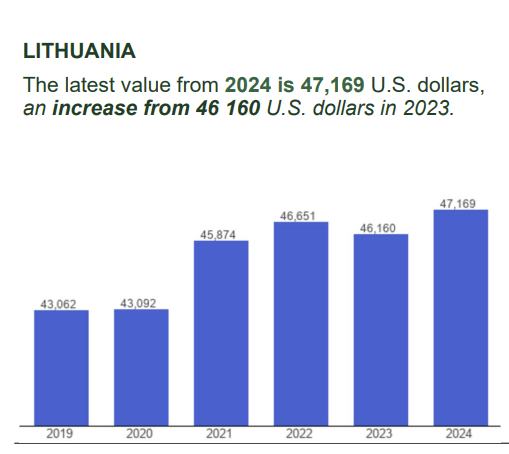
According to official national data, Lithuania's GDP reached €79 billion in 2024, growing by approximately 3% year-on-year, while GDP per capita at purchasing power parity exceeded USD 47,000.
Why Lithuania remains resilient during economic uncertainty
Lithuania's economy has demonstrated resilience through the pandemic, energy-price volatility and geopolitical instability in the region. One reason is diversification. The economy does not depend on one dominant industry, but on a mix of technology, manufacturing, life sciences, engineering, logistics, services and increasingly defence and energy.
Official projections indicate continued economic growth through 2025–2026, supported by exports, foreign direct investment and productivity gains linked to innovation.
Lithuania is increasingly considered a stable operational base inside the EU: internationally connected, relatively cost-efficient and less dependent on domestic demand than many markets of comparable size.
Lithuania's innovation ecosystem and government support for companies
Lithuania's innovation policy is coordinated through Innovation Agency Lithuania, established in 2022 to bring entrepreneurship, export development and innovation support under one national framework.
For foreign founders, this is particularly useful because the support system is not limited to startups. It covers different stages of market entry, commercialisation and international expansion.
Guidance for companies entering and operating in the Lithuanian market.
Support with internationalisation, partner searches and export growth.
Access to innovation initiatives, sandboxes and GovTech programmes.
Acceleration programmes and funding-related support for eligible companies.
Lithuania's strongest business sectors in 2026
Lithuania's attractiveness is not based on a single sector. Several industries have reached enough scale to create specialised talent pools, supplier networks and export ecosystems.
Biotechnology and MedTech
300+ companiesLithuania has made life sciences a strategic national priority, with the sector targeting 5% of GDP by 2030. Vilnius and Kaunas have developed strong research, biotechnology and MedTech ecosystems supported by university-industry collaboration.
ICT, fintech and cybersecurity
8%+ of value addedLithuania has become a recognised technology and fintech hub. Vilnius has built a strong cybersecurity ecosystem, while companies such as Vinted, Nord Security and Teltonika demonstrate the country's ability to create globally scalable technology businesses.
Smart manufacturing and engineering
~20% of GDPManufacturing remains a major part of the economy, with particular strength in lasers, photonics, electronics, robotics and advanced engineering. Lithuanian laser technology is used by 95 of the world's top 100 universities.
Defence, energy and infrastructure
2028 targetDefence and security industries are expanding alongside increased national defence investment. Energy is another strategic focus, with Lithuania targeting 100% renewable electricity consumption by 2028 and investing heavily in wind, hydrogen and grid infrastructure.
1Office Lithuania supports international companies with formation, tax registrations, accounting, payroll and ongoing compliance.
Tax system and investment incentives for companies in Lithuania
Lithuania offers a competitive corporate tax framework by EU standards. From January 2026, the standard corporate income tax rate is 17%, while a 7% preferential rate applies to qualifying small businesses under specific conditions.
| Area | 2026 position | What companies should know |
|---|---|---|
| Standard corporate income tax | 17% | Standard Lithuanian corporate income tax rate from January 2026. |
| Small business rate | 7% | Available only where statutory eligibility conditions are met. |
| R&D incentives | Available | Subject to qualifying activity, documentation and tax rules. |
| Free Economic Zones | Potential incentives | Project-specific and conditional rather than automatic. |
Incentives can include R&D tax relief, accelerated depreciation and benefits available through Free Economic Zones.
Investment incentives are not automatic. They are conditional, project-based and subject to eligibility rules. Companies should assess the tax and legal structure before relying on any incentive in a business case.
Workforce, talent availability and the Lithuanian labour market
Lithuania offers a highly educated workforce with strong participation in science and technology. More than 40% of students choose STEM fields, while Lithuania also has one of the highest shares of women engineers and scientists in the EU.
Wage growth has continued alongside productivity growth. For international employers, the combination of technical talent, competitive operating costs and a digitally advanced environment can make Lithuania attractive for building regional teams.
Why international companies choose Lithuania
Lithuania's appeal is broader than tax rates or startup rankings. International businesses typically evaluate it as a combination of market access, operating costs, talent and regulatory predictability.
- EU legal certainty combined with pragmatic business regulation
- Competitive operating costs compared with many Western European markets
- Strong digital infrastructure and electronic public services
- An export-oriented business culture used to serving international markets
- Access to qualified talent without the cost base of larger European hubs
- A clear corporate, accounting and tax framework
Lithuania is particularly relevant for companies that operate remotely, manage international clients or want to establish an operational base inside the European Union.
What international founders need to set up correctly
Lithuania is business-friendly, but incorporating a company is only the first step. The structure needs to remain compliant once trading begins.
- Correct company formation and registration
- Appropriate tax and VAT registrations
- Ongoing accounting aligned with Lithuanian requirements
- Payroll and employment compliance where staff are hired
- Statutory reporting and communication with Lithuanian authorities
These processes are manageable when the setup is correct. Problems usually arise when international founders treat company registration as the end of the process rather than the beginning of ongoing compliance.
This is where working with a local, experienced partner can materially reduce administrative risk.
Lithuania remains a credible base for international business in 2026
Lithuania has developed into one of the Baltics' most dynamic economies, combining innovation, resilience and openness to international business.
Its strongest argument is not one headline incentive. It is the combination of stable institutions, an export-oriented economy, specialist sectors, technical talent and access to the EU market.
For international entrepreneurs deciding where to establish or expand in Europe, Lithuania remains a serious and practical option in 2026.
Frequently asked questions about doing business in Lithuania
Is Lithuania a good country to start a business in 2026?
Yes. Lithuania combines EU and eurozone membership, an export-oriented economy, strong digital infrastructure and a predictable corporate framework. It can be particularly attractive for international founders looking for an EU base with lower operating costs than many Western European markets.
What is Lithuania's corporate income tax rate in 2026?
The standard corporate income tax rate is 17% from January 2026. A 7% preferential rate can apply to qualifying small businesses where the statutory conditions are satisfied.
Can an international founder operate a Lithuanian company remotely?
Many aspects of company administration can be managed remotely. However, company formation, tax registrations, accounting, payroll and statutory reporting still need to comply with Lithuanian law, which is why international founders often work with a local service provider.
What does 1Office Lithuania help with?
1Office Lithuania supports international businesses with company formation, tax and VAT registrations, accounting, payroll and ongoing compliance.
Ready to do business in Lithuania with confidence?
Get the company structure, tax setup, accounting and ongoing compliance right from the start with support from the local 1Office Lithuania team.
Talk to 1Office Lithuania